
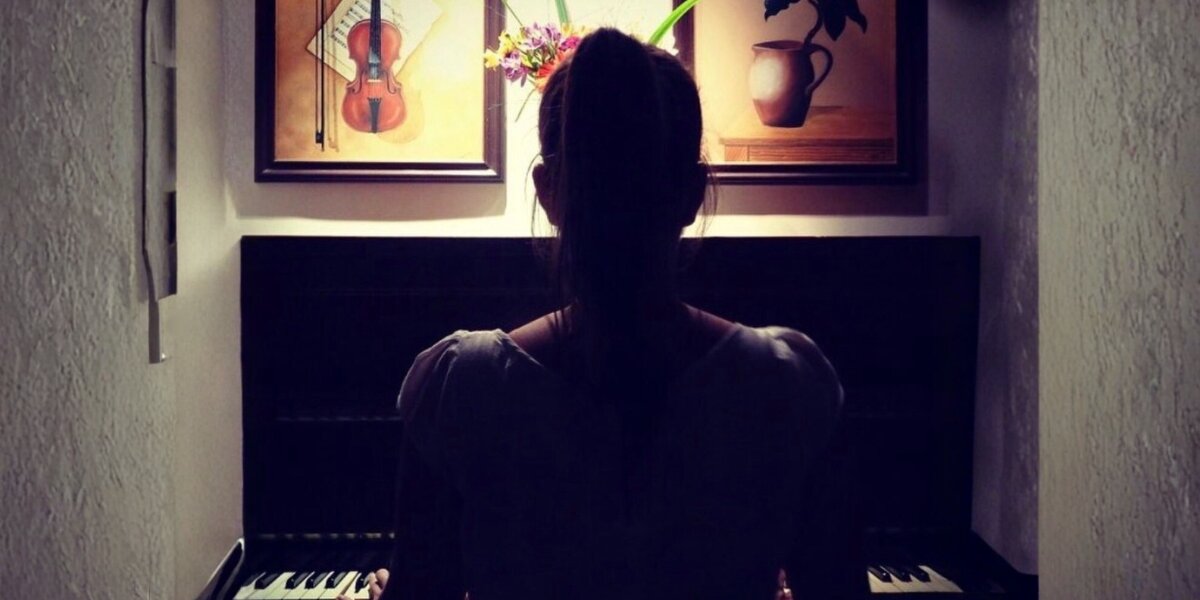
Karol’s work challenges the digital age’s rush, offering an intimate, meditative experience through handmade geometric patterns.
The artist sits in quiet contemplation, ballpoint pen in hand, as the world around her fades into a quiet hum. With each stroke, she enters a space where thought and gesture meet, a practice that transcends the immediate and the tangible. This is the world of an artist who works at the intersection of geometric abstraction, bodily presence, and intellectual meditation. Her art invites viewers to step into a liminal space, one where time slows down, and each line is an act of mindfulness and intention.
The Genesis of Karol’s Artistic Journey
Her practice began not from the desire to create grand statements but from a quiet yearning for presence. The artist’s early years were shaped by an inner compulsion to draw, not merely as an act of representation but as a way of capturing time itself. In a world constantly accelerating and demanding instantaneous results, Karol’s work takes a deliberate step back. Rather than relying on digital tools or algorithms, she returns to the manual, the tactile, and the slow, crafting each piece by hand.
The choice to use a ballpoint pen, often regarded as a humble, everyday tool, adds another layer to this meditative process. It allows her to transcend the limits of polished perfection and embrace the subtle imperfections of human touch. The lines drawn are not sterile or mechanical; they are imbued with the pulse of the hand, a direct connection to the body’s lived experience.
Navigating the Landscape of Contemporary Art
Karol’s practice does not exist in a vacuum. It draws inspiration from a rich lineage of contemporary and historical artists, from the precise geometric patterns of Op Art pioneers like Bridget Riley and Victor Vasarely to the mystical diagrams of figures like Emma Kunz and Hilma af Klint. These artists, in their time, sought to use geometry not just as a form of visual structure but as a medium for spiritual exploration. Karol does the same, but her approach is uniquely personal, drawing not to depict external objects but to manifest an internal equilibrium.
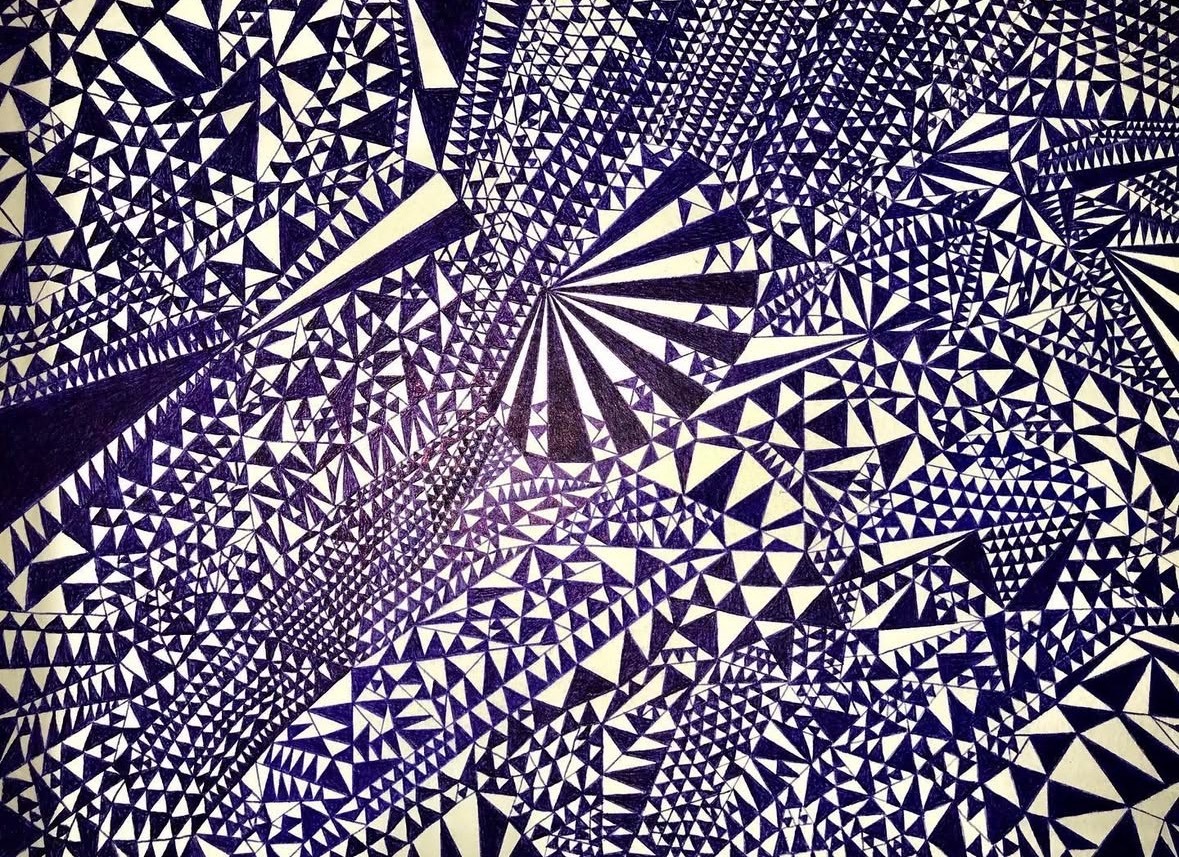
Through repetition and careful observation, her work evolves into a sensory experience that can be both hypnotic and unsettling. Triangles, spirals, undulating lines, and grids emerge, the shifts and variations reflecting a deep engagement with bodily rhythms. As the viewer’s gaze moves across the drawing, the experience becomes one of immersion, where geometry is not merely seen but felt, a physical engagement with the image itself.
For Karol, the very act of drawing is a resistance to the dominant art world’s fixation on immediacy and spectacle. In a culture driven by the need for instant gratification, her practice stands as a quiet protest. The artist’s work does not seek to tell a story, offer an immediate solution, or claim authorship; instead, it invites the viewer into a space of reflection, a place where the image does not need to narrate itself to be profound. This slow and deliberate process is a commitment to something deeper than visual aesthetics, it is a political act, a way of reclaiming time and presence in an increasingly digitized world.
The Spiritual and Somatic Dimensions of Drawing
At the heart of Karol’s practice is the idea that drawing is not just a visual exercise but an embodied one. The patterns she creates are not abstract for the sake of abstraction but rather resonate with the artist’s own experiences, emotions, and bodily rhythms. These works become a sensory field, an invitation for the viewer to engage not just their eyes but their entire body. The viewer is asked to not merely look at the drawing but to feel it, to move with it, to let it draw them in.
This concept of drawing as a somatic experience is informed by thinkers like Erin Manning and Brian Massumi, who emphasize the importance of affect and sensory engagement in contemporary art. Karol’s work does not follow a strict narrative arc. Instead, it presents a series of moments, moments of tension, release, and complexity, that shift and evolve as one continues to engage with them. The act of sustained looking becomes an act of introspection, a meditative process where the viewer’s own body resonates with the rhythms of the drawing.
A Political Act of Handmade Art
In today’s digital age, where much art is produced using computer algorithms or mass-production techniques, Karol’s handmade approach is increasingly rare. The artist’s insistence on using her hand to create these works is not simply a nostalgic gesture; it is a deliberate political statement. It is an assertion of the value of time, presence, and attention in a world that often feels fragmented and rushed.
Each line, every small shift in pattern, speaks to a broader commitment to the ethics of presence. For Karol, the handmade is not just a choice of medium, it is a form of resistance to the growing dominance of algorithmic acceleration and the mechanization of creative practice. It is a reclaiming of time, a refusal to be swept up in the frantic pace of modern life. By embracing the slow, embodied process of drawing, she reasserts the value of the individual hand, the unique imperfection of human touch, and the depth that can arise from sustained, focused attention.
The Spiritual Resonance of Karol’s Work
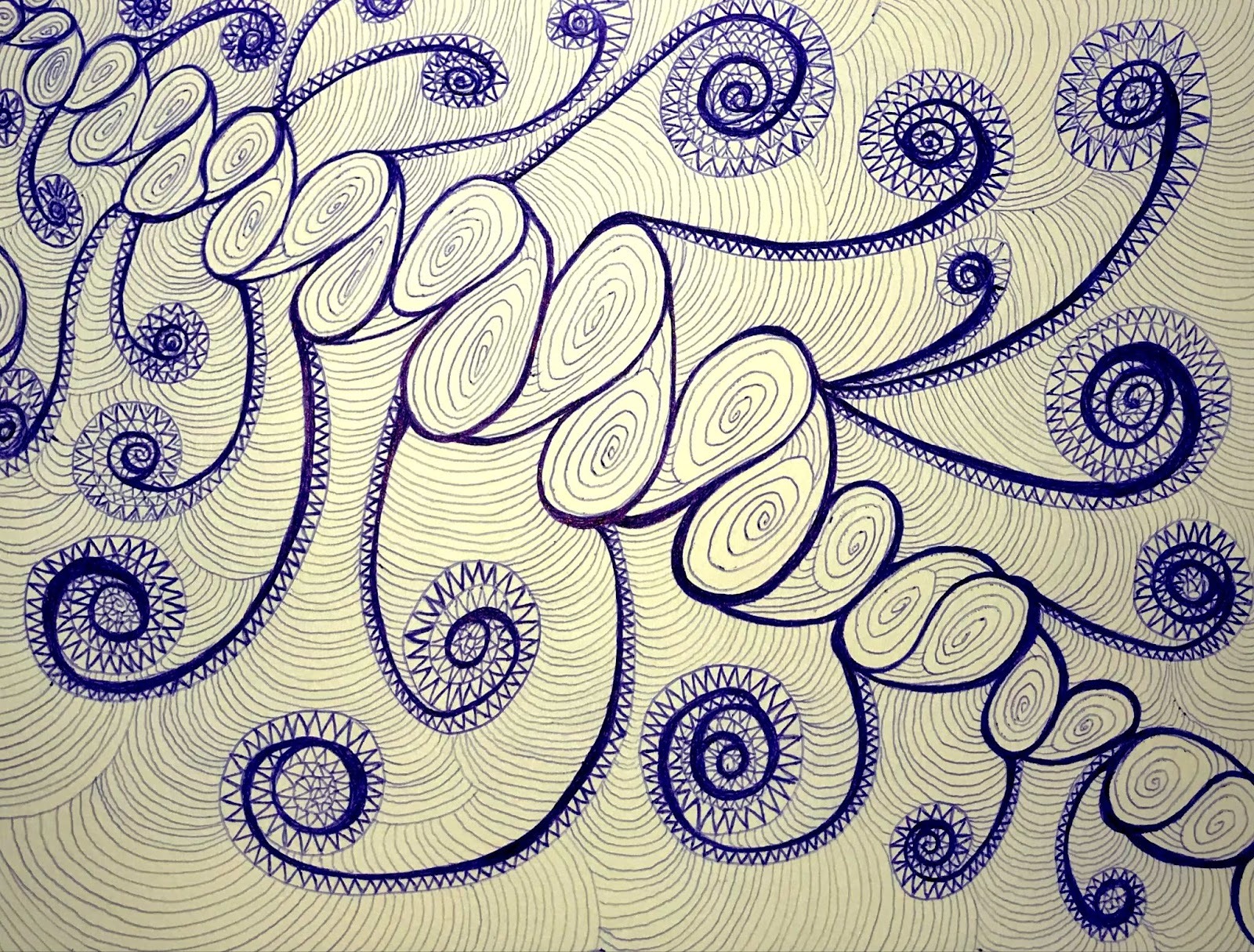
In her work, there is a sense of stillness, a quiet pulse that reverberates through each drawing. The artist’s careful choice of shapes, patterns, and rhythms creates a space for the viewer to enter, to linger, and to find meaning. It is a kind of visual prayer, a meditation on the intersection of mind, body, and spirit.
The patterns that emerge from her pen are not static; they breathe. Each line, each curve, becomes a trace of the artist’s thought, a fragment of an ongoing process. They are not fixed statements but open-ended invitations. These works do not present themselves as completed, finished objects but as living, evolving processes. They are fragments of a larger visual thinking that continues to unfold, inviting the viewer to engage with them in their own time and space.
This quality of incompleteness is part of what makes Karol’s work so powerful. It does not demand immediate comprehension or closure. Instead, it offers a space for the viewer to get lost, to immerse themselves in the rhythm of the drawing, to allow it to unfold at its own pace. It is in this slow immersion that the viewer can experience the full depth of the work, not as a finished product but as an unfolding journey of thought and perception.
Learn more about Karol Z’s art and upcoming exhibitions on their Instagram, Artsy profile, and 1819.